This November, Partners In Health Canada brought together community members, students, advocates, health professionals, and long-time supporters in Montreal and Toronto for The Global Health Activism We Need, a series of conversations shaped by solidarity, fearlessness, and the long arc of structural change. Moderated by PIH Canada National Director Mark Brender, the events featured South African HIV and social justice activist Zackie Achmat, Zanmi Lasante (as PIH is known in Haiti) Executive Director Dr. Wesler Lambert, and PIH Canada Board Chair Dr. Adrienne Chan.
The Montreal gathering on November 5 convened health equity leaders, emerging activists, and PIH supporters. Two days later in Toronto, the evening opened with a powerful thunderbird song from Trevor Stratton, Coordinator of the International Indigenous Working Group on HIV & AIDS (IIWGHA), grounding the space in global Indigenous solidarity.
These reflections unfolded during a challenging political moment. Just days earlier, Canada’s federal budget fell short of expectations for global health commitments, joining cuts already made by the U.S., U.K., Germany, France, Belgium, and the Netherlands. In a broader climate shaped by rising debt burdens, anti-science rhetoric, and growing pressures on fragile health systems, panelists spoke with urgency about the material consequences when global health financing recedes and why renewed resolve is essential.
A symbol that confronted stigma — and still does
One of the most powerful threads across both events came from Zackie Achmat, who reflected on the origins and renewed relevance of the Treatment Action Campaign’s most famous symbol: the HIV POSITIVE t-shirt.
He explained that the shirt was never meant to be a personal disclosure. Instead, it was an act of collective defiance born out of trauma and moral clarity.
“It became very clear that this was not going to be I am HIV positive… It was simply going to be HIV POSITIVE as a challenge to power, to prejudice, to discrimination and to hate — and to say you cannot eradicate all of us.”
The first shirts appeared after a woman in KwaZulu-Natal was murdered for revealing her HIV status. TAC realized that wearing HIV POSITIVE would shift the burden of stigma away from individuals and toward systems of discrimination: an intentional challenge to violence, denialism, and pseudoscience.
Achmat connected that moment to the current global landscape. HIV misinformation once advanced by former South African President Thabo Mbeki has been revived in new forms by public figures such as Robert F. Kennedy Jr. and Donald Trump. In a time when anti-science rhetoric threatens hard-won public health gains, Achmat has begun wearing the shirt again as a statement for this moment of global regression.
“The Real Activists”: Dr. Wesler Lambert on Haiti’s Frontline Workers
Dr. Wesler Lambert brought the audience into the reality of working in Haiti today, where armed groups control most of Port-au-Prince and 80% of health facilities in the capital have closed.
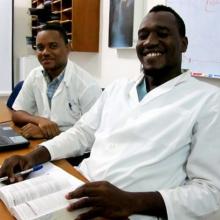
In this environment, Zanmi Lasante’s hospitals and clinics remain open. Lambert emphasized that this is not due to luck, but to the profound moral courage of Haiti’s health workers.
“When we talk about activism — we need those doctors, nurses, cleaners. They are the real activists. They put their life on the line to save people… some of them have options… but they make the decision to stay in the country to keep serving their brothers and sisters.”
Many staff members hold U.S. or Canadian residency and could leave for safety. Yet they choose to stay, even amid kidnappings, fuel shortages, and daily threats, to run emergency rooms, continue HIV and TB treatment, and provide maternal care.
Their consistency is what keeps millions of people connected to care when the broader health system has collapsed. As Lambert noted, activism is protest, but it is also steadfastness in the face of danger and a refusal to abandon one’s community.
What Long-Term Investment Makes Possible: Dr. Adrienne Chan on Malawi
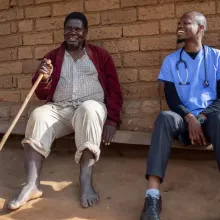
When asked what happens when organizations like Partners In Health “water” health deserts—when real investment and political will confront decades of neglect—Dr. Adrienne Chan described the extraordinary transformations that occur when resources and solidarity align. Drawing on nearly two decades working in Malawi, she reminded the audience that improvements in population health are real and measurable.
“A huge amount can happen… the life expectancy has increased by 20 years. Twenty years. People forget about that.”
Her remarks came in response to a question about whether the current wave of global aid cuts might be seen as an “opportunity” to rethink the system. Dr. Chan cautioned that while foreign aid can be inefficient and shaped by political interests, those shortcomings are not a reason to withdraw support.
“There’s no doubt… there were a lot of inefficiencies… and, in particular, in America it is very tied to American interests, and there’s lots to be critical about.”
But withdrawing aid, she cautioned, is not reform. It is collapse. She described how colleagues in Malawi suddenly could not reach donors or partners for months, leading to drug stockouts, missed appointments, and paralysis in already fragile health facilities.
Her analogy was stark: global health partnerships are like building a house together. When funders abruptly pull away, “someone knocks out a whole wall.” The consequences are immediate and borne entirely by patients.
Activism Grounded in Conscience: Zackie Achmat’s Moral Framework
Throughout the conversations, Achmat kept coming back to a central question: what moves a person to act ethically in a world that is often painful and unjust?
“If you don’t do your activism so you can sleep well at night, then you’re doing the right thing for the wrong reason.”
He spoke about a lifetime of wrestling with questions of dignity, equality, and responsibility, and about the communities, from South Africa to the United States, whose rights remain under attack.
To Achmat, activism is not a performance. It is a way of orienting oneself ethically in the world, especially when it is difficult. Reward, recognition, or career advancement cannot be its motivation; conscience must be.
What’s Next
The Global Health Activism We Need events were part of PIH Canada’s public education and engagement efforts to spotlight global health inequities, strengthen connections across movements, and mobilize support for health systems strengthening around the world.
Partners In Health Canada extends its thanks to the McGill community, PIH supporters, staff, student leaders, and the PIH Canada Board for making the events possible. Special appreciation to Zackie Achmat for his ongoing leadership and advocacy in global health justice.
Listen Again
Missed the event or want to revisit the conversation?
Watch the full Toronto panel discussion: