There’s a version of student activism that stays on campus. Club weeks, bake sales, tabling at club fairs. It matters, and it’s very important, but it often stays local.
That’s not what’s happening inside the Students for Partners In Health Canada network.
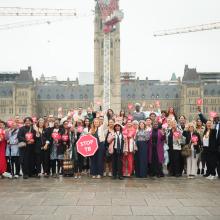
Last September, over fifty student leaders travelled from campuses across the country to Toronto for PIH Canada’s first-ever multi-day Training Institute. Most had never met in person. Many had been building their chapters for years — driving momentum on their own, without ever being in the same room as someone doing the same work three provinces over.
That changed over the Training Institute weekend. (And this year, we’re doing it all over again).
The Training Institute made me more excited and passionate about Student for Partners In Health Canada. It showed me that even though we are just students, we can still have a lot of impact, and people are very receptive to what we have to say. Even the work we are doing can become something bigger — it was very inspiring.” — Kamryn Di Salvo, SFU
The Work

Four students work through organizing strategy at the 2025 Training Institute.
Photo by PIH Canada
Students spent the weekend working through public narrative, campaign strategy, organizing fundamentals, and fundraising.
Some of them used those newfound skills within weeks.
After a session on advocacy led by Results Canada’s Lindsay Sheridan, several students travelled to Ottawa for #LeadOnTB Hill Day. They sat across from Members of Parliament to make the case for stronger federal action on tuberculosis, drawing directly on what they had just learned.
Dr. Ryan Meili’s keynote reframed tuberculosis as a political issue shaped by structural violence and colonial history. That framing is what makes advocacy coherent instead of theoretical. And PIH Engage leader Samantha Kelts’ public narrative workshop pushed students to tell their own stories — she taught students to use their own personal stories as organizing tools to bring people into the mission.
The team seemed more confident after the Training Institute, especially in leading the chapter. It seemed like they gained a lot of insight from the experience, and they really enjoyed it. I think it made the team stronger, both information-wise and connection-wise.” — Maegan Lor, uOttawa
What a Network Actually Looks Like

Chapter leads map out what running a student chapter actually requires: from bi-weekly check-ins to building connections with public health faculty.
Photo by PIH Canada
Before last September, student chapters were doing meaningful work, but it was mostly in parallel. They were active on their own campuses, with limited connection across schools or provinces.
The Training Institute is changing that. Students who met that weekend have stayed in touch. They are co-hosting events, sharing campaign ideas, and building joint initiatives, such as health panels and fundraising events, across campuses.
That’s what a movement starts to look like: shared language, shared strategy, and relationships that outlast a single academic year.
What Comes Next
The 2026 Training Institute is open now, with applications closing June 30.
This year’s cohort will step into something that’s already taking shape: a growing national network of student leaders, alongside returning organizers who bring a full year of momentum with them.
If you are an existing chapter member who wants to take your organizing further than your campus, this is where that happens.
If you are not part of the network, you can join us by starting a chapter here!