When I was an undergrad at the University of Toronto, I was looking for a room of activists. I wanted a community built on shared values. When you’re a student, you often feel that your actions can make a difference. When you voice that, you’re often brushed off as naive. That’s incorrect.
In 1983, Paul Farmer was a recent college graduate waiting to hear back from medical school, volunteering at a hospital in Haiti. A young pregnant woman arrived with severe malaria and needed a blood transfusion. The hospital had none. Her sister was sent to Port-au-Prince to buy blood, and Farmer went around the hospital collecting a dollar here and there until he had $15 for her. It wasn’t enough. The woman and her unborn baby died. Distraught, her sister said, “You can’t even get a blood transfusion if you’re poor.”
Farmer didn’t accept that as the way things are. Through medical school, he went back and forth between Harvard’s classrooms and Haiti’s Central Plateau, where he and a handful of friends, some barely out of their teens, helped build a clinic in Cange. In 1987, years before he finished his degree, they made it official. Partners In Health was founded on the conviction that a death like the woman Paul Farmer was trying to help was manufactured: a result of human choices. And human choices can be changed.
Nearly 25 years later, McGill University started the first Students for Partners In Health Canada chapter. If PIH began with a handful of students, so did its Canadian movement. ❤️
I didn’t know any of that then. I was a philosophy student interested in liberation theology and bioethics. Reading Gustavo Gutiérrez, I kept seeing Paul Farmer’s name surface alongside his. I agreed, in the abstract, that health care is a human right. But I didn’t have a vehicle for that belief, and I had no idea what so many young people were building together after classes.
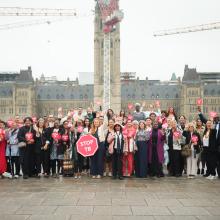
It took joining Partners In Health Canada as staff to find that room. On September 12 and 13, over 60 students and advocates found the room I was looking for when I was their age, at the SPIHC Training Institute weekend in Toronto!

Students settle into the auditorium at University of Toronto on the second day of Training Institute 2026. Photo by Gladys Trinidad / PIH Canada.
Students for Partners In Health Canada nearly doubled this year, from 110 to 190 student leaders and from 12 to 22 campuses. We outgrew our past venue and had to move. When I was a student, I didn’t know this room existed. And this year, it wasn’t big enough.
Farmer once wrote, in conversation with Father Gutiérrez, that “as long as poverty and inequality persist, as long as people are wounded and imprisoned and despised, we humans will need accompaniment — practical, spiritual, intellectual.” Most people remember the first two. The third matters just as much. Conviction doesn’t teach you how to tell your story, make an ask or lobby a government. Someone has to show you, and then you have to practise.
That’s what Training Institute is: intellectual accompaniment. Students have conviction. What they might lack is practice turning it into action, which is the step I never took as a student. So, TI is built like a staircase. Each step asks for a bit more courage than the last, and each one is a skill students take back to their campuses.
Say why you care. Every student wrote their Story of Self: the personal reason they’re in this fight. It’s harder than it sounds. Most people have never had to explain their convictions out loud.
Ask someone for support. In the Fundraising 101 session I ran, students practised making asks using stories they’d written an hour earlier. Some were visibly uncomfortable. They stumbled over their words, but they did it anyway.

An ICL facilitator leads a small group through the Story of Us narrative exercise during a breakout session at Training Institute 2026.
Photo by Crysta Montiel / PIH Canada.
Ask someone with power. At the end of a long first day, more than 55 students called their Members of Parliament at the same time, from the same room, in a callathon led by Lindsay Sheridan of RESULTS Canada. The message was simple: cuts to international assistance must end. It was chaotic, and it was perfect. I’ll admit this one was nerve-racking even for me. The students showed up and showed out anyway.
Put your name on it. Students drafted a declaration together, line by line, UN-style. Anyone could raise a hand and call out a change. Someone would push back, someone else would amend the amendment, and the whole room would vote. It was democracy at its smallest scale, played out in real time, and it kept going until the text said what everyone meant.

Students hold up the SPIHC Declaration, which every Training Institute 2026 participant helped draft and signed on September 13. Photo by Crysta Montiel / PIH Canada.
We, students organizing through Students for Partners In Health Canada chapters, believe in health as a human right for all people. We are allies with students, activists and communities around the world fighting to realize this right.”
The framework behind the weekend, Story of Self, Us and Now, comes from a question the sage Hillel asked two thousand years ago: “If I am not for myself, who will be? If I am only for myself, what am I? And if not now, when?” The students answered the first two. The third is on the rest of us.
In 1970, Canada backed a target proposed by a commission led by our own former prime minister, Lester Pearson: 0.7% of national income for foreign aid. Last year, we gave 0.32%, less than half. Budget 2025 cut another $2.7 billion over four years, and named global health as a target, saying Canada’s contribution had “grown disproportionately.” Meanwhile, TB continues to devastate communities where PIH works. In Malawi, an estimated 4,800 people died of TB in 2023, roughly 13 people a day, and that’s likely an undercount.
Farmer said the idea that some lives matter less is the root of all that is wrong with the world. The students in that room already believed that. At Training Institute, they practised acting on it.
I spent my undergrad looking for this room. If you’re a student, you don’t have to. Find or start a chapter on your campus.

Crysta Montiel
Campaign & Fundraising Specialist
Partners In Health Canada