Universal Health Coverage (UHC) has been a global commitment since 2015 when it was enshrined in the United Nations Sustainable Development Goals, affirming health care as a universal human right. Partners In Health Canada shares this vision: everyone, everywhere, should be able to access high-quality, barrier-free health care.
And yet, for too many people around the world, including in the countries where we work, this promise remains unfulfilled. UHC is still far from reality. Too many patients, especially those living in poverty, are unable to access even basic services. As Dr. Paul Farmer often said, the result is “stupid deaths”: deaths that are entirely preventable with proper, timely health care.
If we are serious about turning the idea of UHC into reality, we must be equally serious about what it actually takes to build health systems that last.
Health systems require sustained public investment
Health systems aren’t built overnight, and they aren’t built for free. They require long-term, reliable investment in infrastructure, supply chains, governance, and health workers.
In Canada, health care spending sits at approximately CAD 8,410 per person, with about 70% funded by government sources. This level of public investment makes universal access possible.
The contrast in many low-income countries is stark. According to World Bank data, annual per-capita health spending looks very different in some of Partners In Health’s care delivery sites:
- Haiti: CAD $72 per person, with only $8 coming from government
- Sierra Leone: CAD $54 per person, with $10 from government
- Malawi: CAD $55 per person, with $7 from government
In these settings, non-government spending fills the gap through NGO projects, private insurance, and patient user fees. These mechanisms often exclude the most vulnerable patients entirely. A country cannot build an equitable, universal health system on less than $10 per resident, particularly when so much of that funding is unpredictable or borne by patients themselves.
The Lancet Commission on Investing in Health estimates that achieving UHC globally would require an additional CAD $483 billion per year—a figure that represents just 0.5% of the G20’s GDP. The challenge is not a lack of resources globally, but how those resources are distributed, governed, and sustained.
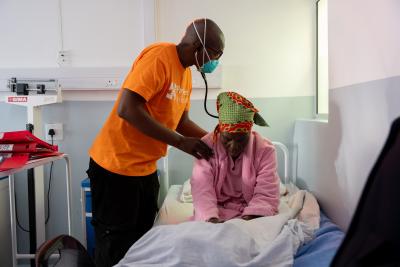
Dr. Sebakeng Phate, multidrug-resistant tuberculosis (MDR-TB) associate lead, examines MDR-TB patient ‘Majanki Lesako during morning rounds at PIH-supported Botšabelo Hospital in Maseru, Lesotho.
Photo by Caitlin Kleiboer / PIH
The limits, and risks, of foreign aid
At Partners In Health, we actively advocate for increased foreign aid to help close this funding gap. At the same time, we recognize the serious limitations of aid-dependent models.
Foreign aid is often volatile, short-term, and shaped by political priorities far removed from the communities it affects. Its roots are deeply entangled with colonial power structures, raising valid questions about equity, sovereignty, and accountability.
Today, those vulnerabilities are on display. The global health community is facing a funding crisis driven by massive cuts to U.S. aid spending, compounded by reductions from other donor countries. Canada has announced $2.7 billion in cuts to international assistance over the next four years, further shrinking an already constrained funding landscape.
While Partners In Health continues to raise funds, speak out against these cuts, and support partners navigating their impacts, we are also engaging in global conversations about what must change if health systems are ever going to be truly self-sustaining.
Moving beyond aid dependency
If countries are to independently fund and govern their health systems, we must address the deeper economic structures that keep them under-resourced in the first place. This requires policy change far beyond the traditional aid system, including:
Ending harmful financial outflows and resource extraction.
Many so-called “poor” countries are rich in natural resources, yet those resources are extracted and exported in ways that primarily benefit corporations and individuals abroad. These outflows drain public revenue that could otherwise support health, education, and social services.
Canceling unjust and unsustainable debt.
In many low-income countries, debt repayment consumes more public funding than health care. These debts—often rooted in unjust historical lending—limit governments’ ability to invest in essential services and must be addressed if health systems are to thrive.
Supporting fair and progressive tax systems.
Many governments rely heavily on consumption taxes that disproportionately burden people living in poverty, while wealth and capital gains remain undertaxed. Strengthening progressive taxation and closing global tax loopholes would help reduce inequality and generate more stable public revenue for health systems.
How PIH builds health systems
Across all of our care delivery sites, Partners In Health works in close partnership with national ministries of health. Our goal is not simply to deliver care, but to help build public health systems that are locally governed and aligned with national priorities.
This means coordinating resources with government plans, offering technical support for policy development, and advocating for other NGOs and donors to do the same. International assistance should function as a stopgap, not a permanent replacement for public systems. When aid fragments services or bypasses governments, it weakens the very systems it claims to support.
For health systems to last, donor governments and institutions must make stable, predictable commitments that allow countries to set their own priorities, plan for the long term, and invest in their people.
Achieving universal health coverage is a technical and political challenge. And it will require bold policy choices that centre equity, sovereignty, and the simple truth that health care is not a privilege; it is an unequivocal human right.