
By Mark Brender
Every health emergency is an opportunity to see if we have learned lessons from the past. This is particularly true for the Bundibugyo strain of Ebola now surging in eastern Democratic Republic of Congo (DRC), where challenges to an effective response are immense.
No licenced vaccine exists for this strain and diagnostics are challenging, meaning the virus went unchecked for weeks before being identified. The outbreak is taking place in an area of longstanding conflict, limiting health worker access and contract tracing. It is difficult to know how cases exist and how many deaths the outbreak has caused so far, but likely many months — and more than $700-million, according to the World Health Organization — will be needed to stop it.
Underlying it all is a health system stretched beyond its limits. The DRC spends about $33 per person on health compared to government health spending of more than $6,900 per person in Canada. Across the world, for four billion people who lack access to quality care, weak health systems are at the root of so many challenges, including during disease outbreaks. And yet, almost in parallel, steep aid cuts from Western governments and the return of tied-aid frameworks last seen in the early 2000s – then explicitly rejected as counter-productive by recipient and donor countries alike, including Canada – have also been spreading.
Canada’s most recent federal budget made the most significant cuts to our international assistance commitments in a generation. The government has also stated Canadian aid should be leveraged to advance domestic economic interests, ensuring “mutual benefit” to Canadians and partner countries.
Details on what mutual benefit means and where it applies remain unclear, but matter deeply. Global health spending represents less than one quarter of one percent of the federal budget, and that number is falling. This raises the urgency for remaining funds to be spent wisely. If the requirement of Canadian economic benefit is applied to our global health aid, it will only deepen the consequences of global inequality the current Ebola outbreak is exposing. The greater the inequality, the more morally dubious our quest for mutual benefit becomes.
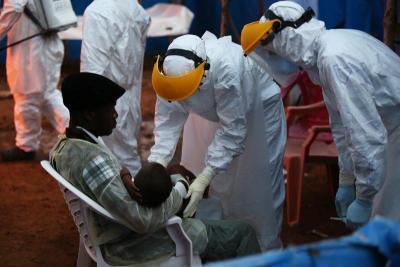
PORT LOKO, SIERRA LEONE - January 09, 2015: Partners In Health clinicians and sprayers receive patients in the triage area of the Maforki Ebola Treatment Unit during the night shift. Photo by R Rollins / PIH
As experts have pointed out, Ebola carries a cruel irony in that it is a disease of caregivers. Because it moves from person to person through contact with bodily fluids, Ebola overwhelmingly infects and spreads through those who are showing compassion: family members providing comfort to sick relatives, nurses and doctors, people who prepare bodies for funerals.
Ebola is also a disease of inequality that thrives where health systems and immune systems are weakest. Diseases and health conditions don’t have fatality rates, health systems and social conditions do.
The West Africa Ebola epidemic of 2014-16 killed 11,000 people including 4,000 in Sierra Leone, where up to three out of every four people who contracted Ebola died. Eight of nine Ebola-infected Western health professionals evacuated from Sierra Leone to Europe or the United States survived – because they were able to access and receive the best supportive treatment when ordinary Sierra Leoneans could not.
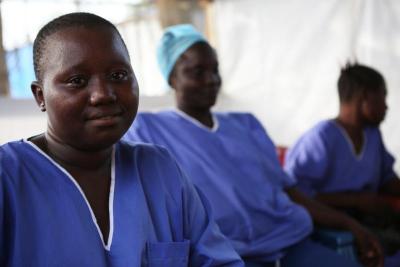
PORT LOKO, SIERRA LEONE - January 09, 2015: Many Ebola survivors worked alongside PIH, Sierra Leonean and Cuban clinicians at the Maforki Ebola Treatment Unit. Aminata M. Bangura lost 12 family members to Ebola, and then helped to care for patients in the ETU. Photo by R Rollins / PIH
Another lesson from the 2014-16 epidemic is that efforts to earn a population’s trust during a crisis, while necessary, are invariably too late. For Ebola, as with all infectious diseases, prevention of transmission in times of crisis is linked with confidence and trust people feel for their health system. To be willing to follow public health protocols, people need to know from experience that their interactions with clinics, hospitals, and health professionals will make them and their loved ones well. Too often in resource-poor settings, that’s not the case. Local communities know all too well that hastily assembled Ebola treatment units might be little more than containment centers designed to prevent transmission rather than to provide life-saving care.
Whether we place blame on legacies of colonialism or conflicts or unfair debt burdens and structural adjustment programs, or even on governments themselves, too many countries don’t have the fiscal space to invest appropriately in health. Ripples from these health system failures spread around the globe in lost trade, fractured relationships, and ill-advised border closures that make it harder to mobilize an effective response. It follows that strengthening weak health systems should be among our top aid objectives.
Investing in health systems costs far less than epidemic response in lives and in dollars – and we know how to do it. Partners In Health leverages the ‘5-S’ approach for health system strengthening: staff, stuff, space, systems, and social support. When we put them in place in partnership with local and national governments, we see better patient outcomes and stronger public sector capacity eventually leading to the country ownership and self-sufficiency everyone desires.
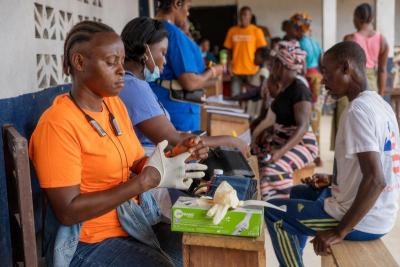
May 20, 2026 - Tina Thomas (left), registered nurse, checks the temperature of Isaac Guzzue’s. PIH Liberia and the J.J. Dossen Memorial Hospital resident doctors team held a free medical screening event for the people of Gabken in rural Maryland County, Liberia. Photo by Aminata K. Massaley / PIH
We also know what is ineffective: multiple donor governments using aid as an opportunity to advance domestic agendas rather than contributing to country-led responses.
Responsive health systems and high citizen trust can and do exist in low-income countries. Rwanda ended a 2024 Marburg outbreak (as dangerous as Ebola) in less than three months due to strong public health measures including activation of thousands of community health workers and a robust underlying health system designed to serve the most vulnerable.
In the aftermath of the 2010 Haiti earthquake and the failure of international assistance to advance Haiti’s long-term development, Partners In Health Co-founder Dr. Paul Farmer outlined principles for improving aid effectiveness in what he called ‘acute on chronic’ contexts, when a crisis magnifies underlying health system weakness. Among his recommendations: The global community should localize aid dollars to create local jobs and boost locaI economies. Donors should allow ministries of health and other agencies to coordinate implementation in line with their needs and priorities. We also need to reassess how we see risk; we often overestimate risks to ourselves and underestimate “the risk of people living in poverty and dying needlessly.”
Finally, we need to make commitments that allow the transfer of aid functions to local authorities – what we now call ‘localization’ – to meaningfully take place. “This is not meant to be an excuse for aid agencies to leave before their local counterparts are strengthened,” Farmer wrote, “but rather a challenge for them to stay as long as it takes until these systems can stand on their own, and possibly even beyond, if needed.”
These are principles of long-term mutual benefit. The zeitgeist may be moving in the opposite direction, but disease outbreaks will end sooner and many more lives will be saved if we follow them.
- Mark Brender is National Director of Partners In Health Canada.